Conflicts are fragmenting, local actors are re-aligning, and external powers are increasingly embedded in domestic security dynamics. Most notably, the past 24 hours have seen a significant escalation in the Sudanese civil war, with more children casualties and fatalities after being struck by drones while attending their morning classes at the mosque.
a. Sudan: Drone Strikes and Peace Negotiations
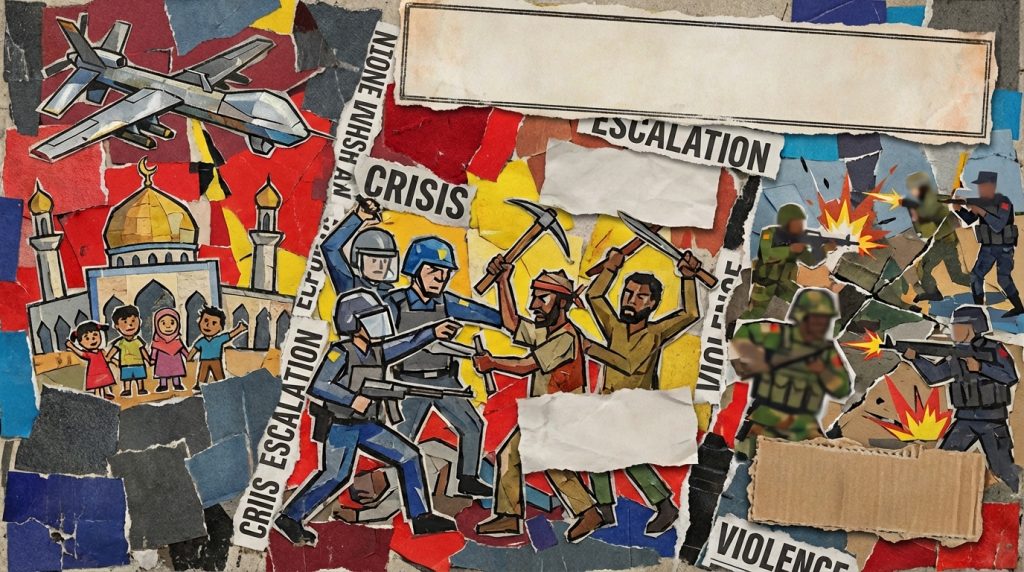
At dawn in al-Rahad, a town in Sudan’s North Kordofan, children gathered inside a mosque for their morning lesson, the quiet routine of study and prayer continuing even as war raged across the country. Then the drone struck, killing two children and injuring more than a dozen others, many of them young students caught inside the building when the blast hit.
Witnesses and doctors say the aircraft struck the mosque without warning, tearing through a space where students had assembled for Quran lessons. Local medical groups attributed the strike to Sudan’s paramilitary Rapid Support Forces (RSF), one of the two main factions locked in the country’s civil war since 2023. The RSF did not immediately comment. For doctors and aid workers tracking the conflict, the attack marked another escalation in a war increasingly defined by aerial strikes on civilian spaces. They described the targeting of children inside a mosque as part of a growing pattern of violations against civilians and places of worship across the country. The strike came amid a broader surge in drone and air attacks across Kordofan, where front lines between the Sudanese army and RSF remain fluid and contested. In recent days, aerial bombardments have hit schools, neighbourhoods and aid infrastructure, deepening civilian vulnerability in a region already under siege. Nearly three years into Sudan’s civil war, the conflict has killed tens of thousands and displaced millions. In towns like al-Rahad, daily life now unfolds under the constant presence of drones overhead, and the knowledge that even spaces of prayer and learning no longer guarantee safety.
b.Shootout in Westonaria as South African Police Service clash with armed illegal miners
Police in Gauteng, South Africa, clashed with suspected illegal miners (“zama zamas”) in Westonaria after mine security reported about 100 miners advancing toward a processing plant. When officers arrived, the group allegedly opened fire with automatic rifles, prompting a shootout in which police returned fire and later, allegedly recovered a bag containing ~75 rounds of AK-47 ammunition.
The confrontation follows a series of recent operations targeting illegal mining networks in the area. Police had already arrested two men the previous day for possession of suspected stolen equipment and seized mining tools and gold-bearing material. Earlier in the week, another armed clash in nearby Carletonville left two suspected illegal miners dead and weapons confiscated, underscoring escalating violence between authorities and heavily armed illegal mining groups in Gauteng.
c. Rebellion risks rise in southeast Central African Republic as Russian-trained militia turns against state
Security conditions in the Central African Republic remain volatile as violence intensifies in remote regions while the capital stays tense but relatively calm. In the southeast, especially Haut-Mbomou prefecture, clashes have escalated since the December 2025 presidential election. The Azandé Ani Kpi Gbè (AAKG) militia, once recruited and trained by Russia-linked Wagner Group, has broken with the government and is now fighting both state forces and rival rebels such as the UPC around towns including Zémio and Bambouti. This fragmentation of armed groups could trigger a broader insurgency in the southeast and destabilise already fragile security dynamics.
In the capital Bangui, calm has largely held following the re-election of President Faustin-Archange Touadéra, though the city remains heavily secured with strong reliance on foreign partners and Russian-linked forces to deter attacks. The broader context remains severe: about 2.3 million people, a third of the population, require urgent humanitarian assistance, while the UN has extended the mandate of the MINUSCA peacekeeping mission through November 2026. Ongoing foreign involvement, militia realignments and possible spillover from Sudan continue to shape a fragile and unpredictable security landscape.