
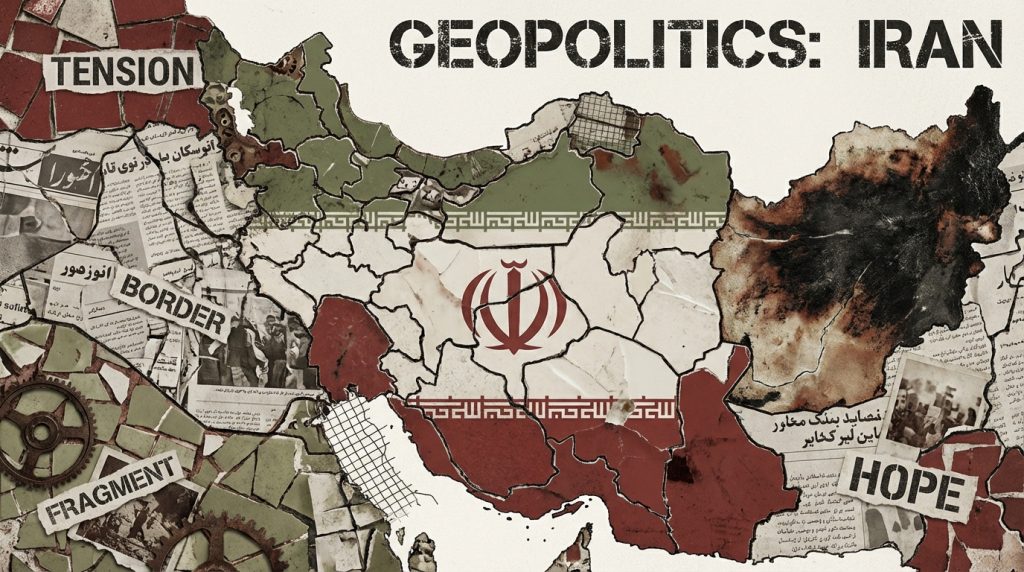
The History: How the Iranian system was built, and why it is breaking
With the stakes established, the history becomes legible. Every covert operation, every proxy war, every diplomatic failure was a move inside a system that each actor was simultaneously building and contesting.
a. Sovereignty as scar tissue (1953–1979)
In 1953, the removal of prime minister Mohammad Mosaddegh through a coup orchestrated by the CIA and MI6 did more than change a government. It changed the credibility of a political pathway. Mosaddegh had attempted a secular, nationalist assertion of sovereignty: nationalize oil, rebalance power, and keep Iran’s statehood from being negotiated in foreign capitals. When that attempt was reversed from outside, two lessons calcified in the Iranian political subconscious.
First: foreign powers could and would decide Iran's future if the state's coercive apparatus was not under loyal control.

Second: moderation could be punished, not rewarded. A secular nationalist project had been tried, and it had been crushed.
Those lessons did not create the 1979 revolution on their own. But they supplied its moral logic: we are not merely reforming governance; we are immunizing sovereignty. The Shah’s rapid modernization, paired with repression, narrowed the lanes of opposition until the mosque became the last durable organizing platform.
Out of this narrowed landscape, two ideas emerged as more than slogans. They became state-building instruments.
1. Gharbzadegi (Westoxification), popularized by Jalal Al-e-Ahmad, framed Western influence as a civilizational disease, not a matter of taste, but of contamination.
2. Velâyat-e Faqih (Guardianship of the Jurist), articulated by Ayatollah Khomeini, turned clerical authority into sovereign authority. The jurist was not a moral guide standing above politics. He became the locus of the state.
The 1979 USA Embassy hostage crisis was not simply a diplomatic rupture. It became an internal sorting mechanism. Hardliners used it to purge moderates and to permanently close the door on normal relations with Washington. The new state’s identity fused to siege: a revolutionary order cannot be safe unless it is permanently vigilant.
This is the first reason the triangle becomes inevitable. Once the Islamic Republic defines itself through resistance to USA influence, it also defines itself through opposition to the USA-anchored regional order, of which Israel is a keystone.
War as a factory: How endurance became doctrine (1980–1988)
a. The Iran-Iraq War industrialized institutions. It normalized emergency powers, hardened command culture, and scaled domestic mobilization into a way of life. A revolution that might have softened into a republic instead learned to survive like a garrison. Most importantly, it elevated the IRGC from revolutionary militia to permanent state pillar. The IRGC’s legitimacy did not come from ballots or bureaucratic competence; it came from sacrifice narratives and war-making capacity. That form of legitimacy later allowed it to become a political, economic, and intelligence actor, not merely military. When the war ended, the Islamic Republic emerged exhausted, but with the governance logic of permanent threat hardwired into its institutions. That logic became the architecture of Khamenei’s era.
b. The Khamenei System: A parallel state built around a single switch (1989–2010)
When Ayatollah Khomeini died in 1989, Iran faced a succession problem. Ali Khamenei was not the most senior cleric. He was not the natural marja figure that a theocracy might have selected. But he was politically positioned, and the system chose survivability over hierarchy. Khamenei’s response to initial vulnerability was structural overcompensation. He reconfigured the state into a parallel architecture designed to be coup-proof and reform-proof: redundant institutions, competing power centers, and ultimate arbitration concentrated in the Leader’s office.
Over time, the elected state became an interface. The Leader’s office became the router. The Artesh remained, but the IRGC became decisive. Parliament and ministries handled policy, but parastatal wealth handled loyalty.
Official intelligence existed, but IRGC intelligence handled regime survival. Financial independence mattered because patronage in a security state is not scandal, it is function. A Leader who controls unaccountable funding controls the payroll of obedience.
This is also where Iran’s forward-defense model consolidated into a regional system.
c. The Axis of Resistance; Iran’s relationship with Hezbollah, Palestinian factions, militia networks, later the Houthis was framed as insurance: keep conflict away from Iranian borders by engaging adversaries abroad. For decades, this shadow warfare held. It allowed Iran to signal resolve without stepping into direct war.
But systems built on indirectness eventually face a ceiling. Adversaries adapt. Attribution improves. And the center becomes targetable.
A decade of escalation: From covert sabotage to direct exchange (2011–2020)
If Khamenei’s earlier era built the machine, 2011 onward shows the machine being tested in the gray zone and gradually forced out into daylight.
a. Covert war and the shadow of the nuclear program (2011–2015).
The early part of the decade was defined by a multifaceted shadow war centered on Iran’s nuclear trajectory. While international diplomacy moved in public, an attritional contest unfolded in secret: sabotage, assassinations, and cyber operations. Targeted killings of individuals connected to nuclear work became a recurring pattern. The deaths were not only tactical losses; they were psychological signals that Iran’s most protected programs were penetrable.
Cyber became a parallel theater. After the Stuxnet disruption of Natanz, subsequent malware campaigns targeted Iranian industrial capacity and institutional confidence. The Quds Force, meanwhile, continued arming and training militants across multiple fronts. In Iraq, Iran-linked militias that had fought USA forces did not vanish after 2011; they evolved, and many were folded into formal security structures during the anti-ISIS campaign, creating an environment where USA forces operated alongside armed actors whose loyalties were not purely Iraqi.
In Gaza, cycles of Israel-Hamas confrontation (2012, 2014) showed how Iranian support for Palestinian factions could translate into pressure on Israel while preserving Tehran’s deniability. The strategic grammar was reinforced: escalation could be outsourced. Diplomacy briefly appeared to offer a reset. The 2015 JCPOA placed constraints on Iran’s nuclear program in exchange for sanctions relief, an attempt to lower the temperature without settling the deeper ideological conflict.
b. Maximum pressure and regional confrontation (2016–2020).
The post-JCPOA period saw USA policy swing sharply. The withdrawal from the deal and the “maximum pressure” campaign reintroduced economic siege as strategy, while Israel intensified its campaign to prevent Iranian entrenchment in Syria. Israel’s strikes there were not random; they were a sustained effort to disrupt weapons flows to Hezbollah and prevent a long-term Iranian military infrastructure from taking root. The Syrian theater became the proving ground of a new Israeli principle: fight Iran’s military presence as close to the supply chain as possible.
The USA-Iran track escalated directly at the end of the decade. A militia rocket attack in Iraq killed a USA contractor in late 2019; the USA response culminated in January 2020 with the assassination of Qassem Soleimani. Iran’s ballistic missile retaliation against Ain al-Asad demonstrated willingness to strike openly. By late 2020, the shadow war returned to the nuclear domain with the killing of Mohsen Fakhrizadeh. The message was consistent: the nuclear project was not only a technical program. It was a target set.
c. The Slide into direct war: When proxies stopped being a buffer (2021–June 2025)
The early 2020s did not end the proxy era, but they eroded its usefulness. The Gaza War that erupted on October 7, 2023, detonated the region’s escalation ladder. Israel’s response transformed Gaza into a prolonged conflict, while the war’s political energy spilled outward.
In the Red Sea, the Houthi campaign against shipping and long-range launches toward Israel turned maritime trade into a battlefield. A USA-led naval response formed to ‘protect’ shipping corridors pulling Washington deeper into a theater shaped by an Iran-aligned actor.
In 2024, the conflict crossed a historic threshold: direct Iran-Israel exchanges. An Israeli strike on Iranian facilities in Damascus and Iran’s subsequent direct launches (Operation True Promise and later True Promise II), created a new baseline. Tehran and Tel Aviv could now exchange blows openly, without allies as the primary interface. These exchanges also revealed a hard limit: coalition air defense blunted much of Iran’s direct attack profile, forcing Iran to confront the reality that deterrence through volume could be neutralized by layered defenses.
Then came June 2025 : the Twelve-Day War.
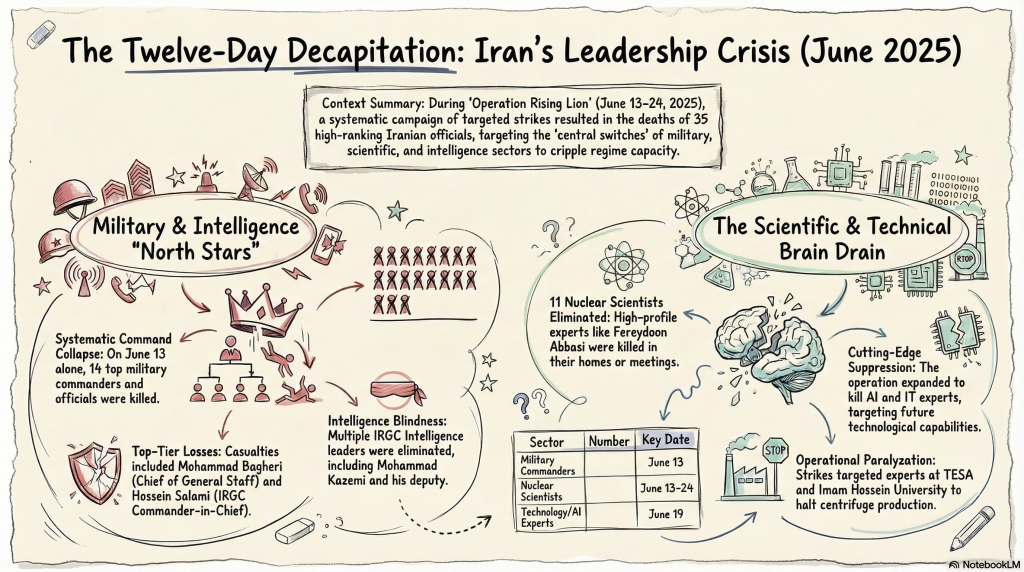
Israel’s campaign, Operation Rising Lion, functioned as a systems strike: degrade air defense, disrupt strategic infrastructure, and remove senior operators. The logic was not only damage but demonstration. A state that sells invulnerability cannot survive public proof of penetrability. The United States entered directly with Operation Midnight Hammer, striking critical nuclear sites. Whatever the tactical outcome, the strategic meaning was clear: Iran’s core infrastructure had become, in the eyes of Washington, a legitimate target in a high-intensity exchange.
Throughout the conflict, the Supreme Leader’s invisibility, and his reported retreat to a fortified bunker produced a profound legitimacy rupture. In a garrison state, myth is not ornament. It is a control surface.
d. The Switch is removed moving a damaged system to vacuum (Feb–March 2026)
By early 2026, Iran’s internal landscape was already strained by repression and protest cycles. The regime could still coerce, but coercion had become costlier, and legitimacy thinner. In that setting, coordinated strikes of late February codenamed Operation Epic Fury (USA) and Operation Roaring Lion (Israel) targeted the heart of Iran’s parallel state: Beit Rahbari. On March 1, Iranian state television confirmed the death of Ali Khamenei.
The immediate significance was obvious. The deeper significance was structural: Iran’s parallel state was designed for a single operator. Remove the operator, and the redundancies that once prevented coups become rival command nodes.
Four failures followed in quick succession:
1. Command continuity failure. The IRGC is optimized for loyalty to the Leader. Without an arbiter, rival fiefdoms compete.

2. Patronage liquidity failure. Unaccountable asset empires and funding streams become contested. The payroll of loyalty becomes a battlefield.

3. Legal–theological failure. Institutions whose authority derives from the Leader face a legitimacy short-circuit.

4. Provincial enforcement failure. Local security actors hedge—either overreacting or withholding compliance as they wait to see who wins.
An Interim Leadership Council inherits tools but not aura. It can issue orders, but it cannot easily reproduce the metaphysical seal that made obedience feel inevitable.
This is the final reason the triangle matters. Israel and the United States did not merely seek to punish Iran; over time, they came to view Iran’s security architecture itself as a generator of instability. Iran, in turn, came to view Israeli and USA power as proof that sovereignty requires insulation and forward defense. Each side’s doctrine validated the other’s threat narrative.
By March 2026, the result is not victory. It is a vacant garrison state: heavily armed, financially vast, and internally uncertain. The revolutionary slogan, ‘Neither East nor West’, ended not with triumph but with a question: what happens to a fortress when its gatekeeper is gone?
The geopolitical meaning of an empty chair
A vacuum is rarely empty. It invites pressure, opportunism, and miscalculation. In a region where deterrence is as much psychological as material, the death of the Supreme Leader is not only an Iranian succession issue. It is an external signaling event. Neighbors test borders. Proxies splinter or freelance. Great powers reprice risk. Markets move on rumor.
The central switch has been removed but the machine still hums. But it no longer knows what it is protecting, or who it is obeying.
Mwende Mukwanyaga- the conflict ledger