

Part 2: How Iran, Israel, and the United States became a single battlefield
In the public sphere, the Iran-Israel-USA triangle is often treated as a set of separate disputes that occasionally collide: a nuclear standoff here, a proxy skirmish there, an airstrike in Syria, a cyber incident in the shadows. But our Conflict Ledger tells a different story.
Over seven decades, these conflicts fused into a single, interlocking system;one in which ideology became security policy, security policy became regime survival, and regime survival became a regional order problem. By March 2026, that system reached an end-state that felt less like resolution: the assasination of the Supreme Leader, the central switch that routed authority through Iran’s parallel state, produced not merely a leadership crisis but a geopolitical vacuum. The story is not simply that Iran lost a leader. It is that a state designed to run through a single operator suddenly had no operator, while its two principal adversaries had already evolved their doctrines to treat the Iranian core as targetable.
Before we trace how we got here, we need to answer the question most readers arrive with first: why did Israel and the United States care enough to go this far?
The Stakes: Why the Iran became a target
For decades, the conflict was a shadow war of proxies and sabotage. By 2024, the buffer of deniability had worn thin. The stakes had shifted from influence to irreversible capabilities. Understanding what each actor stood to lose or gain, is the only way to make sense of what followed.
a. Israel’s Stake: The doctrine of existential prevention
For Israel, the stake in Iran is not territorial, and it is not primarily about regime type. It is about capability timelines. Israel operates under what strategists call the “Begin Doctrine”, the principle, first applied against Iraq’s Osirak reactor in 1981, that Israel will not allow any regional adversary to acquire weapons of mass destruction. Applied to Iran, this doctrine produced three interlocking fears.
Fear 1. The nuclear threshold as a shield. Israel's core stake is preventing Iran from reaching a ‘threshold state’, a position where it could produce a weapon quickly, even if it chose not to. In the Israeli view, a nuclear-capable Iran, even one that never fires a weapon, gains a permanent umbrella of immunity. Under that shield, Iran could escalate proxy wars in Lebanon, Syria, and Gaza with the knowledge that Israel would be deterred from striking the Iranian heartland. The bomb, in this logic, is not a weapon of last resort. It is a license for permanent, low-level war.


Fear 2. The ‘Ring of Fire’ synchronisation. By 2023, Israel no longer viewed Hezbollah, Hamas, and the Houthis as separate threats from Iran. It viewed them as a synchronized ring, a multi-front pressure system capable, if coordinated, of launching a saturation attack that would overwhelm the Iron Dome and Arrow defense systems simultaneously. The stake was to break that coordination before it matured into a single, timed strike.


Fear 3. The precision revolution. Iran's transition from unguided rockets to precision-guided munitions changed the math. Israel could no longer afford to absorb strikes and retaliate later. It had to interdict the supply chain at the source which meant striking inside Iran, not just at its proxies.
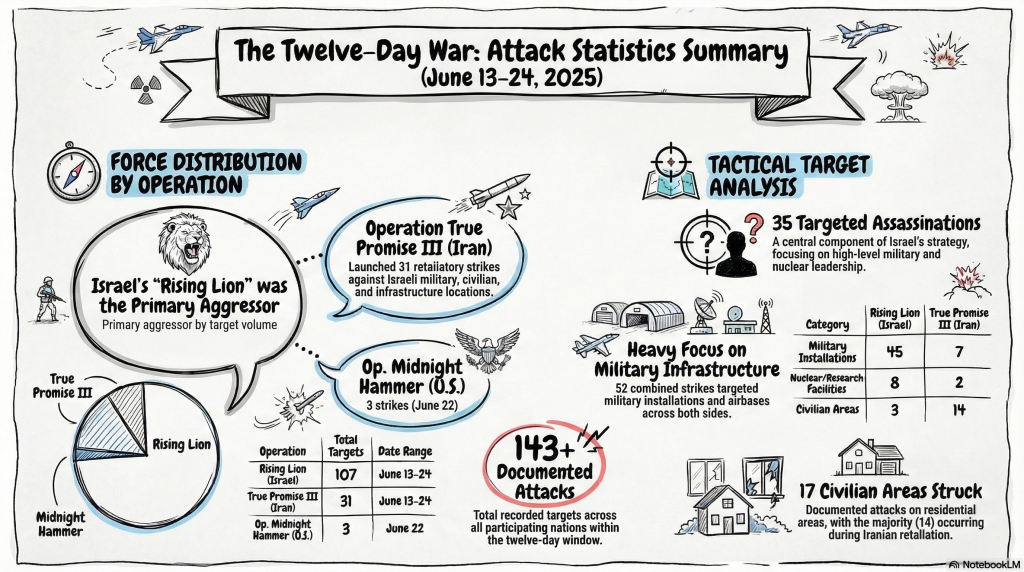
In the Twelve-Day War of June 2025, Israel’s stake was to reset the clock. By targeting air defenses and senior IRGC coordinators, Operation Rising Lion sought to prove that the Ring of Fire had a vulnerable center.
The message was not only military. It was psychological: the fortress is penetrable.
b. The American Stake: The credibility of the global commons
Washington’s stake in Iran is systemic. While Israel focuses on survival, the USA focuses on order, specifically, the maintenance of a rules-based regional architecture that keeps sea lanes open, allies protected, and nuclear proliferation contained.
Stake 1: Force protection. With thousands of troops stationed in Iraq, Syria, and across the Gulf, the USA's stake begins with the safety of its personnel. When Iran-backed militias began using advanced drones and ballistic missiles against USA bases culminating in the 2024–2025 escalation cycle, Washington faced a binary choice: retreat and signal that American forces are a cost-free target, or re-establish a credible ‘cost of entry’ for attacking Americans. Retreat, in the logic of deterrence, is not neutral. It is an invitation.

Stake 2: Freedom of navigation. The Strait of Hormuz and the Bab al-Mandab are the carotid arteries of the global economy. Iran's demonstrated ability to disrupt 20% of the world's oil flow, or to weaponize the Houthis against Red Sea shipping, is not a regional problem. It is a global one. Operation Midnight Hammer in June 2025 was, at its core, an assertion that the global economy cannot be held hostage by gray-zone tactics from a regional power.

Stake 3: Non-proliferation and precedent. If Iran successfully navigated the ‘Maximum Pressure’ era to emerge as a nuclear power, the USA- led non-proliferation regime would face a credibility collapse. Saudi Arabia, Turkey, and Egypt had each signaled interest in their own programs if Iran crossed the threshold. The U.S stake was to prevent a proliferation cascade, not only in Iran, but in the precedent it would set for every other state watching.
Why the Shadow Failed: The Shift to Direct Action
By 2024, both Israel and the USA had concluded that containment, as practiced, had failed. The shadows were no longer dark enough.
1. The attribution revolution: Advances in satellite imagery, signals intelligence, and cyber-forensics made plausible deniability increasingly difficult to sustain. When a drone hit a ship or a missile hit a base, the digital fingerprints led back to the IRGC. The gray zone was becoming transparent.
2. The proxy ceiling: Proxies like Hezbollah had grown so capable that they were no longer buffers, they were front lines. To stop the proxy, adversaries concluded they had to strike the logistics and command hub in Iran itself. The supply chain ran through Tehran.
3. The ‘Central Switch’ logic: Both intelligence communities identified that the Iranian system was uniquely top-heavy. Unlike a decentralized democracy, Iran’s parallel state relied on a small number of critical nodes: the Supreme Leader’s office, the Quds Force leadership, and the Setad financial engine. Remove the nodes, and the system loses its coherence. This insight would define the terminal phase of the conflict.
Written by Mwende Mukwanyaga, edited by Lilian Mutinda.