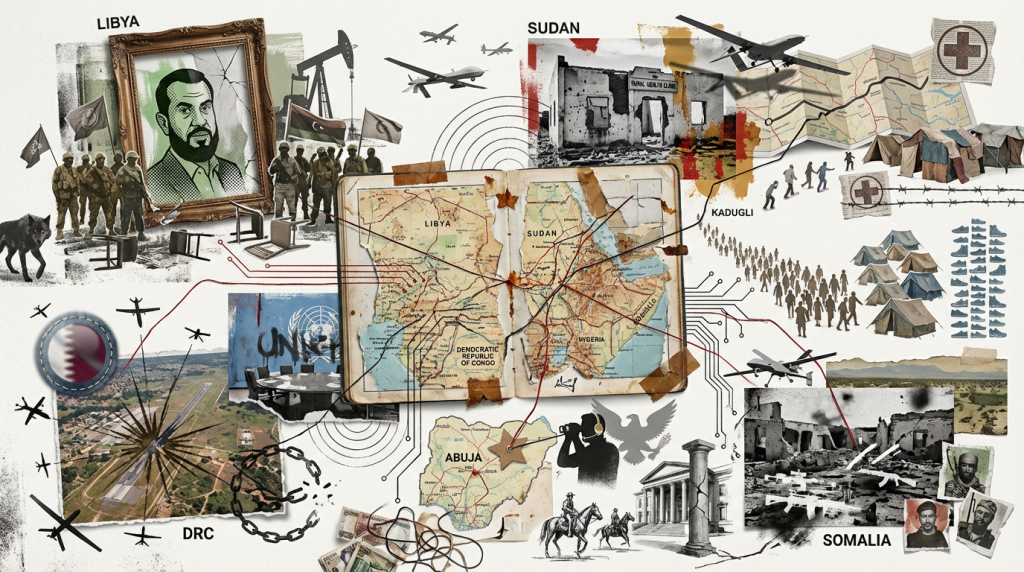
The past 24 hours have seen a significant escalation in conflict in West Africa, marked by one of the deadliest massacres in Nigeria’s recent history in Kwara State. In East Africa, the conflict in the Democratic Republic of the Congo (DRC) has entered a new technological phase with rebel-led drone strikes on strategic military infrastructure. Humanitarian conditions remain dire across the Sahel and Sudan, with millions facing famine as active combat continues to disrupt aid corridors.
a. Massive gunmen attack in Kwara State, Nigeria
On February 4, 2026, a deadly attack unfolded in Woro and nearby villages in Kaiama Local Government Area of Kwara State, Nigeria, killing ~162 civilians. Armed men, believed to be bandits or jihadist militants possibly operating from neighbouring Niger State, surrounded the area while residents were gathered for a religious sermon. Witnesses say the attackers demanded that locals pledge allegiance to Sharia law before opening fire on the community. In the chaos that followed, shops were looted and homes set ablaze, forcing survivors to flee and leaving widespread destruction in their wake. Authorities suspect the assault may have been a retaliatory strike linked to recent military operations in the region, highlighting the fragile security situation and the growing threat of armed groups across parts of northern and central Nigeria.
b. JNIM IED attack on military convoy, Burkina Faso
On February 04 2026, a military convoy travelling near Djibo in Soum Province, northern Burkina Faso, was struck by an improvised explosive device in an attack claimed by JNIM, an Al-Qaeda affiliate active across the Sahel. The roadside bomb detonated as the convoy moved through the area, destroying four military vehicles and underscoring the persistent vulnerability of security forces operating in the region. The attack forms part of JNIM’s broader strategy to isolate key northern urban centres such as Djibo by targeting military movements and supply routes, thereby weakening state presence and tightening militant control over surrounding territories.
c. M23 drone strike on Kisangani Airport, DRC
A precision drone strike targeted a military drone control centre at Bangoka International Airport in Kisangani, Tshopo Province, in the Democratic Republic of Congo, in an incident reported on February 4, 2026, following related developments between January 31 and February 1. AFC/M23 rebels claimed responsibility for the strike, identifying the facility as a key drone operations hub used by the Congolese Armed Forces (FARDC). According to the group, the attack was carried out using their own drone capabilities and framed as a “preemptive defense” operation. The strike appears aimed at weakening FARDC’s aerial surveillance and strike capacity, a move that could significantly affect battlefield dynamics by limiting the military’s ability to monitor and target rebel-held areas.
d. Clashes in Ituri Province, DRC
Clashes between government forces and militia fighters in eastern Democratic Republic of Congo intensified on February 04 2026, in the localities of Duunga and Bule in Djugu Territory, Ituri Province. The confrontation began when units of the Congolese Armed Forces (FARDC) reportedly launched an offensive into the area, prompting a counter-attack by militants from the Cooperative for the Development of Congo (CODECO/CRP). Fighting between the two sides forced civilians to flee as control of the area shifted, with militia forces reportedly pushing government troops back toward Bule. The violence reflects ongoing territorial competition and deep-rooted ethnic tensions in Ituri’s gold-rich zones, where armed groups and state forces continue to contest authority and access to resources, leaving local communities repeatedly displaced.
e. Fragile Security in Tripoli, Libya
The killing of Saif al-Islam Gaddafi on February 3, 2026 has introduced a new layer of uncertainty into Libya’s already fragile political landscape. Once seen as the political heir to his father, former Libyan leader Muammar Gaddafi, Saif al-Islam had remained a symbolic and potentially unifying figure for pro-Gaddafi constituencies despite holding no formal state power in recent years. His continued relevance rested on tribal loyalties, nostalgia for pre-2011 stability, and his attempted re-entry into national politics during Libya’s stalled 2021 presidential process.
According to multiple reports and his lawyer’s, armed attackers stormed his residence in Zintan and fatally shot him, prompting Libyan authorities to open a formal investigation. The identity and affiliation of the perpetrators remain unclear, a reflection of Libya’s fragmented security environment where militias and competing armed networks continue to operate with relative impunity. International and regional actors, including the African Union and Russia, have condemned the killing and called for accountability, warning that the assassination could undermine already stalled reconciliation and transition processes.
Saif al-Islam’s death removes a symbolic “third force” in Libya’s political equation. For years, Libya’s power balance has revolved around rival authorities in Tripoli and the eastern military bloc aligned with Khalifa Haftar. Saif represented a potential alternative political centre rooted in pro-Gaddafi networks that still hold influence in parts of the country. With his removal, those networks may fragment or seek new alliances, increasing the risk of localized tensions or retaliatory mobilization. At the same time, some analysts suggest his absence could reshape calculations ahead of any future electoral process, eliminating a controversial but influential contender whose candidacy had previously complicated negotiations.
The broader stability outlook for Libya remains precarious. The country continues to face a dual-authority structure, competing armed factions, foreign interference, and repeatedly delayed elections. While Saif al-Islam’s killing alone is unlikely to trigger immediate nationwide conflict, it reinforces a pattern in which political competition is mediated through armed force rather than institutional mechanisms. In the short term, the assassination raises the risk of political realignment, militia maneuvering, and further delays to national reconciliation efforts. In the longer term, it underscores the enduring fragility of Libya’s transition and the absence of a unified security and governance framework capable of preventing high-profile targeted killings.
Conclusion
The immediate outlook for several regions will depend on whether these trends consolidate into sustained escalation or remain localized shocks. Key indicators to watch over the next 24–72 hours include possible retaliatory or realignment dynamics within Libya’s militia networks following Saif al-Islam’s killing; the potential expansion of drone-led operations by both state and non-state actors in the DRC; further mass-casualty attacks or coordinated reprisals in Nigeria’s north-central corridor; and the continued ability of Sahelian militant groups to disrupt military supply routes and isolate urban centers.