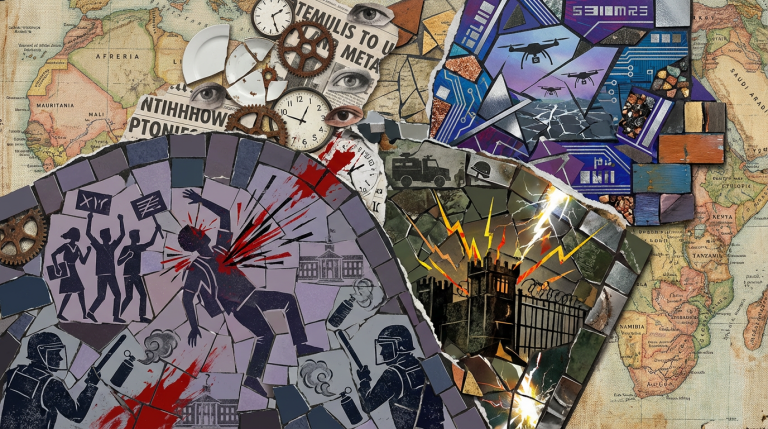
A Conflict Ledger Women’s Day Ode to Iranian Women | March 8, 2026
“The regime did not simply oppress women. It built itself around them, using their bodies as the most visible proof that the revolution was still governed.”
A note from the editor before we begin
Today is International Women’s Day. In most of the world, that means celebration, recognition of progress, of resilience, of the women who changed things. In Iran, it means something more complicated. It means looking at a country where women have been, simultaneously, the most controlled and the most defiant political actors of the last century. Where a headscarf is not a garment but a constitutional requirement. Where a woman cutting her hair in public is not a fashion choice but an act of political warfare.
This piece is a forensic account not a condemnation of a faith, a culture, or a people. Islam, like every major religion, contains multitudes: centuries of scholarship, diverse jurisprudence, and hundreds of millions of practitioners whose relationship to gender, law, and governance varies enormously. What this piece examines is not Islam. It examines a specific political project; the Islamic Republic of Iran, and the specific ways that project used state power to control women’s lives. The distinction matters. Conflating the two is not only analytically wrong; it does a disservice to the Iranian women who have fought, and continue to fight, from within their own cultural and sometimes religious frameworks.
Because the most honest thing we can do on Women’s Day, for Iranian women specifically, is to understand exactly what was built to contain them, how they dismantled it piece by piece, and what it cost.
Part I: How women became the state’s most important surface
In a secular authoritarian state, the regime claims legitimacy through order: security, economic function, stability. In a theocratic state, the regime claims legitimacy through moral order. It does not merely govern. It embodies divine governance.
That distinction has one enormous consequence for women: If the state’s authority rests on its claim to moral order, then women’s visible compliance becomes the state’s most legible proof that it still governs. This is why, in the Islamic Republic, women are infrastructure. Their dress is regulated not by social convention, but by law. Their movement is policed not by community, but by state apparatus. Their defiance is prosecuted not as personal choice, but as political threat. Their bodies are narrated by state media, by clerical decree, by constitutional framing. Once you see this, the recurring cycle of the last 47 years becomes legible: Legitimacy crisis → enforcement intensification → women resist → crisis deepens → repeat.
Every time the Islamic Republic has felt threatened by war, economic collapse, international isolation, or internal dissent, it has tightened its grip on women first. Because women are the most visible way to signal that the doctrine still holds. And every time it has tightened that grip, women have pushed back harder.
Part II: The precedent that made everything possible
a. 1936: Reza Shah and the politics of forced unveiling
The Islamic Republic did not invent the idea of legislating women’s appearance. It inherited the logic and inverted it. In 1936, Reza Shah Pahlavi issued a decree banning the veil as part of a top-down modernization campaign modeled on Atatürk’s Turkey. Women were forcibly unveiled in public. Police removed headscarves from women who refused. Some women stopped leaving their homes entirely rather than appear unveiled. The garment changed. The mechanism was identical: the state using women’s appearance to signal national direction.
This is the precedent that matters. Not the specific policy, but the established logic that a woman’s body is a legitimate surface for state ideology. The Islamic Republic would use the same mechanism in reverse and with far greater institutional depth.
b. 1963: The White Revolution and women’s suffrage
Under Mohammad Reza Shah, the White Revolution of 1963 granted women the right to vote and stand for election. The Family Protection Law of 1967 (expanded in 1975) gave women greater rights in divorce, child custody, and marriage age. These reforms were real but they were also regime branding. The Shah used women’s advancement as proof of Iran’s modernity and Western alignment. This matters because it set up the revolutionary reversal: when Khomeini came to power, dismantling women’s rights was not only ideological, but it was also a symbolic repudiation of the Shah’s entire legitimacy project.
The lesson embedded in this history: when a regime makes women’s status its emblem, its successor will re-legitimate itself by reversing that emblem.
Part III: The revolution arrives, and the reversal begins (1979)
a. February-March 1979: The first protests are by women
Here is the fact that history tends to bury: The first mass protests against the Islamic Republic were by women, and they happened within weeks of the revolution. On March 8 1979, (International Women’s Day), tens of thousands of women marched in Tehran against Khomeini’s announcement that women would be required to wear the hijab in government workplaces. They chanted “We did not make a revolution to go backwards.” They were met with harassment, violence, and dismissal. The revolution that many women had supported against the Shah’s authoritarianism had already begun to turn against them.
b. 1979-1983: The legal architecture of control is built
The Islamic Republic did not impose gender control all at once. It built it systematically, layer by layer.
- In 1979, the Family Protection Law suspended immediately after the revolution. This law had given women rights in divorce, custody, and marriage. Women lost the right to initiate divorce on equal terms. Child custody defaulted to fathers. The minimum marriage age for girls was lowered to 9 (later revised to 13).
- 1980: Gender segregation was institutionalized in schools, universities, and public spaces. Women were barred from certain fields of study and professions, including the judiciary: a ban that would persist for decades.
- 1980-1983: Compulsory hijab enforced in government workplaces in 1980. By 1983, it was criminalized for all women in public, punishable by flogging (later converted to fines and imprisonment). The Gasht-e Ershad (morality police) would eventually become the enforcement arm of this law.
- The Islamic Penal Code (1983) codified the Islamic law into the penal code and institutionalized gender inequality at the deepest level: A woman’s testimony was given half the weight of a man’s in certain legal proceedings; Blood money (diyeh) for a woman’s death was set at half that of a man; Stoning was codified as punishment for adultery and ; Execution of girls was permitted from age 9. These were not just social norms anymore.
Part IV: The Iran-Iraq War (1980–1988) where women were sacrifice symbols
War does not only militarize borders but also societies. During the eight-year Iran–Iraq War, the regime recast women’s role from “compliance surface” to “sacred guardian of the home front.”
Women were:
* Mothers of martyrs: the regime’s most powerful emotional currency
* Moral anchors of the “Sacred Defense” narrative
*Logistical supporters: soldiers, nurses, supply chain workers, civil defence volunteers
The war gave the regime a new use for women: grief as legitimacy. A mother weeping for her martyred son was proof that the revolution was worth dying for. But the war also had an unintended consequence: it pulled women into the workforce and public life out of economic necessity. Women who had been pushed out of certain professions found themselves needed. The contradiction between “women as domestic guardians” and “women as necessary labor” would deepen in the decades that followed.
Part V: The Laws of Inequality
a. The Guardianship System: Legal childhood for adult women
Iran’s guardianship laws (velayat) create a system in which adult women remain legally subordinate to male relatives in key domains of life.
- Marriage: A woman requires her father’s or paternal grandfather’s permission to marry for the first time, regardless of her age.
- Travel: A married woman requires her husband’s written permission to obtain a passport and travel abroad. This is law codified in the Passport Law.
- Divorce: A man can divorce his wife unilaterally (talaq). A woman seeking divorce must prove specific grounds (harm, abandonment, addiction) in court; a process that can take years and often fails.
- Child custody: After divorce, custody of children above age 7 (boys) and age 9 (girls) defaults to the father. Mothers can lose custody entirely if they remarry.
- Inheritance: Daughters inherit half the share of sons. A wife inherits one-eighth of her husband’s estate if they have children; one-quarter if they do not.
- Employment: A husband can legally prevent his wife from taking a job he deems incompatible with “family interests.”
This is legal architecture designed to ensure that women’s lives remain structurally dependent on male authority, which in turn remains structurally dependent on clerical authority, which in turn remains structurally dependent on the Supreme Leader. The chain of control is theological, legal, and domestic; simultaneously.
b. The Hijab Laws: Dress as constitutional document
The compulsory hijab law is the most visible expression of the regime’s gender doctrine, and the most contested.
- 1983: Hijab made compulsory for all women in public. Punishment: 74 lashes (later converted to fines and imprisonment of up to two months).
- Gasht-e Ershad (Morality Police): Established formally in 2005 under Ahmadinejad, though morality enforcement had existed since the early 1980s. Patrols arrested women for “improper hijab”; hair showing, tight clothing, makeup. Women were taken to “re-education centers,” fined, or imprisoned.
- 2023 Hijab and Chastity Bill: Following the 2022 uprising, the regime passed a new, harsher hijab law. Penalties were escalated: fines of up to 360 million rials, imprisonment of up to 10 years for repeat offenders, and, most significantly, businesses and employers could be penalized for allowing unveiled women on their premises. The law attempted to make enforcement collective rather than individual. The hijab law is not primarily about modesty. It is about visibility of compliance. A woman in a headscarf is a woman the state can see obeying. A woman without one is a woman the state cannot control.
Part VI: The Movements (How women fought back, era by era)
a. 1979: The first resistance (Before the ink was dry): As noted above, the first organized resistance to the Islamic Republic’s gender policies came from women themselves on International Women’s Day, 1979. The marches were suppressed. But the pattern was established: women would not accept the reversal without a fight.
b. 1990s: The Reform-Era Civil Society Surge: The post-war reconstruction period and the Khatami presidency (1997–2005) created a brief opening for civil society. Women’s organizations, legal advocacy groups, and feminist publications proliferated within the red lines of what the state permitted.
Key developments:
- Women’s NGOs expanded, focusing on legal reform, domestic violence, and labor rights.
- Feminist journals like Zanan (Women) founded by Shahla Sherkat in 1992, became platforms for legal and cultural critique. Zanan was eventually shut down in 2008.
- Women entered parliament in larger numbers, though the Guardian Council routinely disqualified female candidates.
- Legal challenges to discriminatory laws were filed and argued, rarely won, but establishing a record.
The state's response: tolerate until it threatens the guardianship core, then constrain.c: 2006: The One million signatures campaign: One of the most significant organized women’s rights movements in Iranian history.
What it was: A grassroots campaign launched in 2006 to collect one million signatures demanding legal reforms specifically to discriminatory laws on marriage, divorce, inheritance, and testimony.
How it worked: Activists went door-to-door, to parks, to workplaces explaining the laws, collecting signatures, and building a network of women who understood their own legal subordination in concrete terms.
Why it mattered: It was a legal education campaign disguised as a petition drive and it directly challenged the regime’s claim that Islamic law was accepted by Iranian women.
State response: Mass arrests. Dozens of campaign organizers were imprisoned. The campaign was never completed but it built the organizational infrastructure that would fuel later movements.d. 2009: The Green Movement and women’s visibility: The 2009 post-election protests (the Green Movement) were not primarily a women’s movement, but women were central to them. Women were among the most visible protesters. The image of Neda Agha-Soltan, shot dead on June 20, 2009, her death filmed and circulated globally, became the defining image of the movement.
Neda was a bystander. Her death, and the way it was filmed and shared, demonstrated something the regime had not fully anticipated: in the digital age, the spectacle of state violence against women could not be contained.
State response: The Green Movement was suppressed. But it established the template for 2022.e. 2017-2018: Girls of Revolution Street: Beginning in December 2017, women began standing on utility boxes and street corners in Tehran, removing their headscarves and waving them on sticks in silent protest. The action was inspired by Vida Movahed, who stood on a utility box on Revolution Street (Enghelab Street) in Tehran on December 27, 2017.
Why it was significant: It was a symbolic tactic of extraordinary precision. By standing silently in public, unveiled, the women forced the state into an impossible choice: Arrest them (and prove the law is coercive, not consensual), or Ignore them (and prove the law is unenforceable).
State response: The state arrested them. Dozens of women were detained. But the images spread globally and the tactic spread domestically. Vida Movahed was arrested, released, and became a symbol. The women who followed her became known as the "Girls of Revolution Street."f. 2019: The Bloody November Protests: The protests triggered by fuel price hikes, were not primarily about women’s rights. But they revealed the regime’s willingness to use lethal force against its own population.
Estimates of those killed range from 304 (Amnesty International) to over 1,500 (Reuters). The internet was shut down for days.
Women were among the protesters, the dead, and the imprisoned. The protests deepened the legitimacy fracture that would explode in 2022.
e. 2022: “Woman, Life, Freedom” : September 16, 2022: Mahsa (Zhina) Amini, a 22-year-old Kurdish-Iranian woman, died in the custody of the Gasht-e Ershad (morality police) after being arrested for “improper hijab.” The regime claimed she died of a heart attack. Her family, witnesses, and medical evidence suggested she was beaten.What followed was the most sustained domestic challenge to the Islamic Republic since 1979.
What made WLF different from previous uprisings:
- Women were the emblem. Previous protests had economic or political triggers. WLF was triggered by the death of a woman at the hands of the gender enforcement apparatus. The cause was inseparable from the system.
- The slogan was a doctrine. “Zan, Zendegi, Azadi” (Woman, Life, Freedom) was a counter-theology. The clarion call was that women’s freedom was a foundational condition of a livable society.
- The tactics were embodied. Women cut their hair in public. They burned their headscarves. They danced in the streets. These were direct physical refusals of the state’s claim over their bodies.
- It crossed ethnic and class lines. Across Kurdish, Baluch, Azeri, Persian the protests spread across Iran’s ethnic geography in a way previous uprisings had not.
- Men joined as allies, not leaders. The movement was led by women. Men participated in support. This inversion of the usual protest hierarchy was itself a political statement.
What WLF broke: The regime’s claim that its gender doctrine was accepted, or at least tolerated, by Iranian women. After WLF, that claim was no longer sustainable
State response: Lethal. The regime deployed live ammunition, birdshot, and security forces. Estimates of those killed range from 500+ (human rights organizations) to the regime's own much lower figures. Thousands were arrested. Executions of protesters followed..
g. 2023-2026: The Chastity Bill, the “Year of Blood,” and the Succession Vacuum:
- 2023 Hijab and Chastity Bill: The regime’s response to WLF was not reform. It escalated pressure against women. The new hijab law passed in 2023 was the harshest since 1983; extending penalties, criminalizing businesses, and attempting to make enforcement collective.
- 2026: The “Year of Blood”: In the project’s internal narrative, the crackdown following the Twelve-Day War and the legitimacy fracture of 2025-2026 produced a period of intensified repression. The gap between state-acknowledged deaths (3,117) and activist estimates (36,500) became the terrain upon which the regime lost its last claim to moral authority.
Women were at the center of this period both as targets of enforcement and as the most visible axis of resistance.
The succession vacuum question: With Khamenei gone and an Interim Leadership Council in place, the gender enforcement apparatus faces a structural dilemma: Enforcement requires a theological arbiter. The Council is a committee, not a marja. Relaxing enforcement risks signaling doctrinal collapse. Intensifying enforcement risks igniting the most mobilizable opposition force in the country. There is no clean exit from this dilemma. Which is why women remain, in 2026, exactly where they have been since 1979: at the center of the Iranian state’s most unresolvable contradiction.
Part VII: Some of the women who refused
A forensic account is not complete without names the history must keep.
- Neda Agha-Soltan: killed June 20, 2009. Her death, filmed and shared globally, became the face of the Green Movement.
- Vida Movahed: the first “Girl of Revolution Street,” December 2017. Arrested. Released. Became a symbol.
- Mahsa (Zhina) Amini : died September 16, 2022, in morality police custody. Her death ignited WLF.
- Nasrin Sotoudeh: human rights lawyer, repeatedly imprisoned for defending women and children. One of Iran’s most prominent legal advocates.
- Narges Mohammadi: human rights activist, Nobel Peace Prize laureate (2023), imprisoned multiple times. Continued writing and organizing from prison.
- Shirin Ebadi: Iran’s first female judge before 1979, Nobel Peace Prize laureate (2003), forced into exile. Has never stopped speaking.
- Sepideh Rashno: arrested in 2022 for not wearing hijab on a bus. Appeared on state television in what was widely assessed as a coerced confession. Her case became a flashpoint.
They are evidence that resistance was never extinguished, and that the cost of defiance was paid, repeatedly, by real women with names.
Conclusion
The Islamic Republic made women the most visible surface of its ideological authority. For 47 years, it used their dress, their movement, their legal status, and their bodies to signal that the revolution still governed; that God’s law, as interpreted by the Supreme Leader, still held. What it did not anticipate was that the same visibility that made women useful as a compliance surface would make their defiance catastrophically legible. When women burned headscarves in the streets of Tehran in 2022, they were not rejecting a garment. They were rejecting the constitutional theology of the state in public, on camera, in a language the whole world could read.
And on this International Women’s Day, March 8, 2026; with Iran in the middle of a succession vacuum, a legitimacy fracture, and a society that has already paid the price of defiance in blood, the question is who gets to write the next chapter, and whether the women who bled for it will be in the room.
Written by Mwende Mukwanyaga in conversation with Lilian Mutinda and Maryanne.