
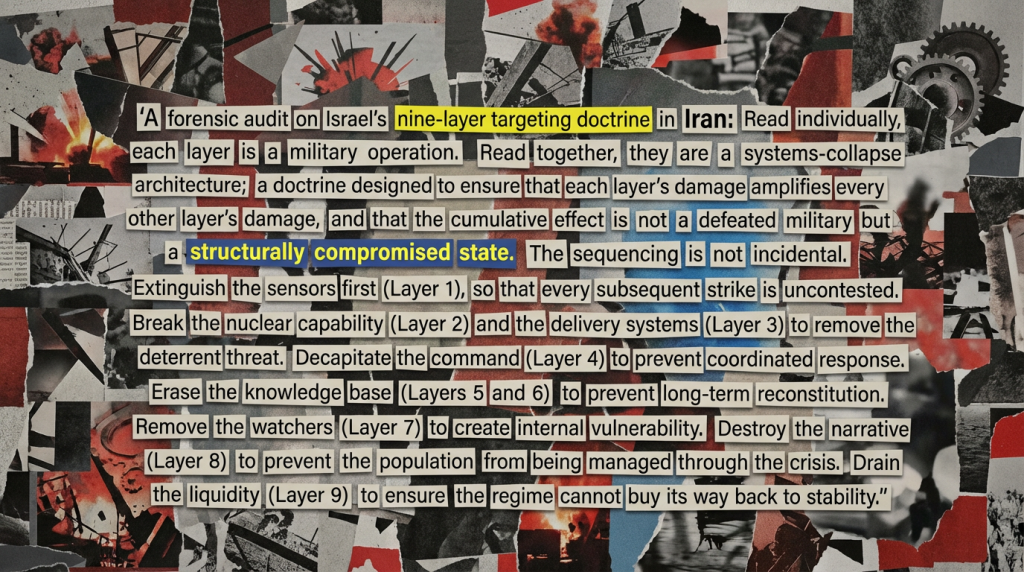
This is a dissection of the method and logic behind what was struck, in what order, and why the sequencing matters as much as the targets themselves. What follows is a tactics-first audit of a doctrine designed not to win a battle, but to engineer a long-term collapse curve.
Layer 1: Destroy air defence and radar
Primary tactic: Kinetic suppression of enemy air defenses (SEAD) combined with cyber-electronic warfare, executed in the opening minutes of Operation Rising Lion.
Before a single bunker buster was dropped on Fordow, before a single scientist was targeted, before a single missile battery was struck, Iran was rendered sensor-dark. This is the foundational logic of Israel’s entire doctrine: you do not strike a defended target; you first remove the defense, then strike everything else at will. The ‘Great Prophet’ radar network, (Iran’s integrated air defense system (IADS), built over two decades with Russian S-300 components, domestically produced Bavar-373 batteries, and layered early-warning infrastructure), was suppressed within approximately 120 minutes of the opening salvo.
The method was not purely kinetic. Electronic warfare assets jammed communications between radar nodes and command centers, creating a gap between what sensors detected and what commanders could act on. Simultaneously, precision strikes on radar installations and command-and-control nodes removed the physical infrastructure. The result was not degradation, but total operational blindness. What this destroys is not just hardware. It destroys the confidence to move. Once radar is suppressed, every asset becomes huntable: convoys, leadership vehicles, mobile launchers, and hardened sites that were previously protected by the assumption of detection. The psychological effect on defenders is as significant as the physical one; you cannot defend what you cannot see, and you cannot coordinate what you cannot communicate.
Why the sequencing is irreversible: Air defense is not rebuilt under fire. Every subsequent layer of the doctrine; nuclear sites, missile production, command decapitation, was only executable because this layer was compromised first. Remove Layer 1 from the sequence and the entire doctrine collapses.
Rebuild timeline: 2-4 years under optimal conditions, assuming supply chains remain open, trained operators survive, and foreign components (particularly Russian) remain available. Under sanctions, with degraded technical personnel, and with the knowledge that the system failed catastrophically once, the psychological rebuild may take longer than the physical one.
Layer 2: Create cascade failure in nuclear facilities
Primary Tactic: Substation destruction to trigger cascade power failure across enrichment infrastructure; GBU-57A/B Massive Ordnance Penetrators for buried hardened sites.
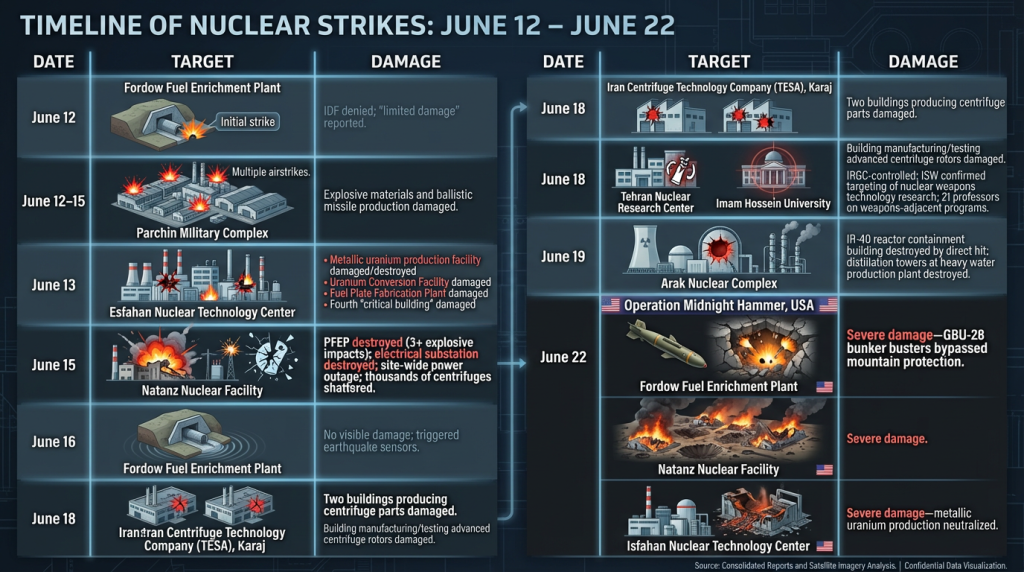
The nuclear targeting logic is more sophisticated than it appears in most reporting, which tends to focus on the dramatic imagery of bunker busters and underground facilities. The doctrine did not begin with the bunker busters. It began with the power grid. Before kinetic strikes on Fordow, Natanz, and Isfahan’s nuclear research complex, the electrical substations feeding those facilities were struck. This is a deliberate sequencing choice with a specific operational logic: a nuclear enrichment facility running on emergency backup power is not a functioning enrichment facility. Centrifuge cascades require extraordinarily stable power supplies; and fluctuations cause mechanical failures, contamination events, and cascade shutdowns that take weeks to recover from even under normal conditions.
The substation strikes created the conditions for cascade failure before the physical structures were struck. By the time bunker busters reached Fordow’s underground halls, the facility was already operationally compromised. The physical strikes then compounded damage that was already accumulating.
What this destroys beyond the obvious: The doctrine targets systems, not buildings. You can repair a wall in weeks. Restoring stable power, instrumentation calibration, safe operating conditions, and the confidence to resume operations under the threat of follow-on strikes is a fundamentally different problem. The Atomic Energy Organization of Iran’s statement that Fordow suffered ‘limited damage’ may be technically accurate about the physical structure while being entirely misleading about operational status. A facility that cannot safely operate is not a functioning facility, regardless of whether its walls are intact.
The deeper logic, and why Fordow specifically: Fordow is buried under a mountain near Qom, built precisely because it was designed to survive conventional airstrikes. Its targeting, and the IDF’s subsequent denial of striking it, reflects a deliberate ambiguity strategy: create operational paralysis while maintaining deniability, forcing Iran to publicly claim damage (and thus acknowledge vulnerability) or publicly deny damage (and thus be unable to explain the operational shutdown).
Rebuild timeline: 5-10 years for full operational restoration and that estimate assumes the human knowledge base remains intact. As Layers 5 and 6 will demonstrate, it does not.
Layer 3: Break the delivery system end-to-end of the missile production chain
Primary Tactic: Simultaneous strikes on propellant fuel plants, manufacturing facilities, component storage, and mobile launch transporter-erector-launchers (TELs).
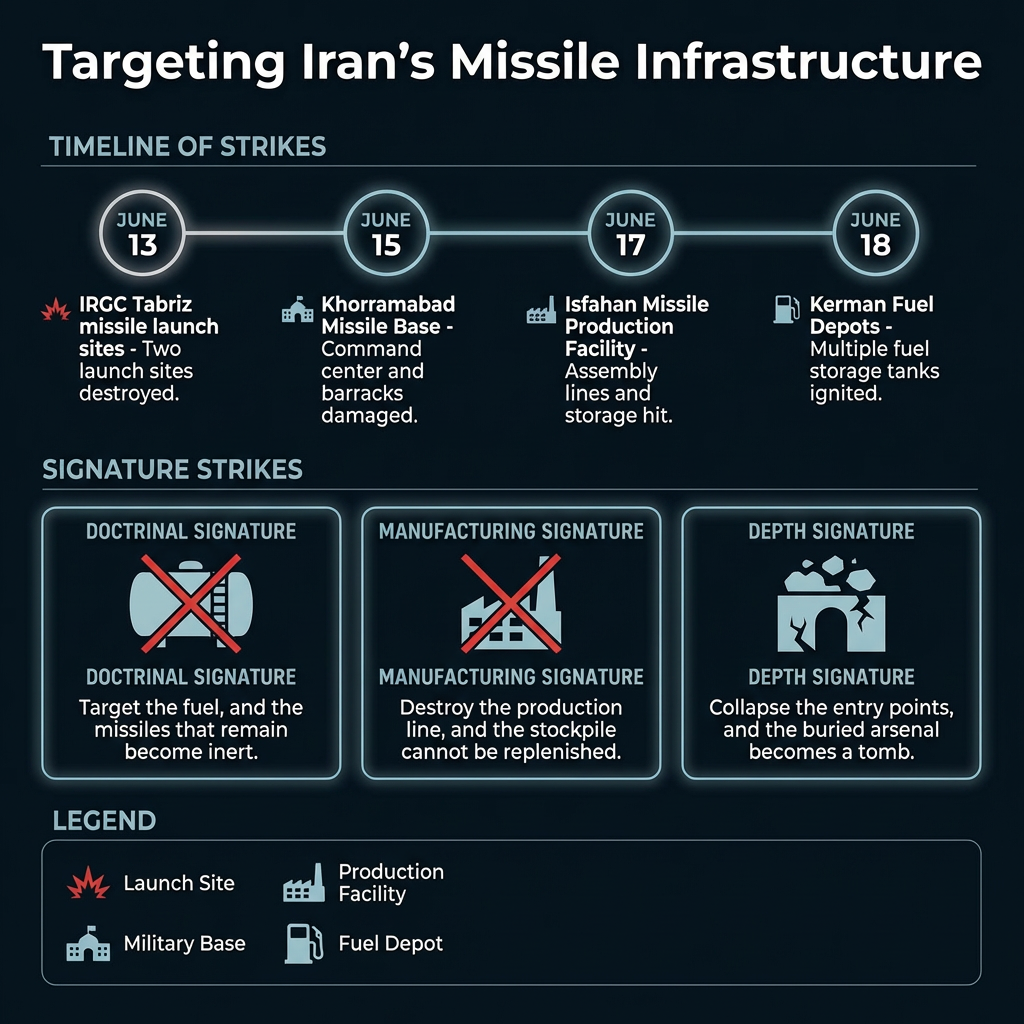
A missile force is a supply chain with a warhead at the end of it. The doctrine understood this distinction and targeted accordingly. The critical insight here is the difference between attrition and reconstitution denial. Attrition destroys what exists. Reconstitution denial destroys the capacity to replace what is destroyed. A missile force can absorb significant attrition if any segment of the production and logistics chain remains intact; factories can rebuild inventory, storage can be dispersed, launchers can be hidden. The doctrine targeted the chain as a chain, striking fuel production, manufacturing, storage, and mobile launchers simultaneously to prevent any single surviving segment from anchoring a recovery.
By Day 9 of the Twelve-Day War, Iran’s retaliatory capacity under Operation True Promise III had been reduced to salvage launches; firing what remained of pre-positioned inventory rather than executing a coordinated strike campaign. The asymmetry between the opening salvos of True Promise III and its final days reflects not a change in Iranian intent but a collapse in Iranian capability.
The mobile launcher problem: TELs are notoriously difficult to target because they are, by definition, mobile. Their inclusion in the simultaneous strike package suggests a level of pre-war intelligence penetration either through signals intelligence, human sources, or both, that allowed real-time tracking of launcher positions. This has implications beyond the Twelve-Day War: it suggests that Iranian operational security around its most mobile assets had been compromised before the first shot was fired.
Rebuild timeline: 3-7 years for industrial capacity restoration, assuming components, skilled labor, and secure basing can be reconstituted. The timeline extends significantly if the technical workforce has been degraded; which, again, Layers 5 and 6 address directly.
Layer 4: Decapitate, then kill the replacement of senior military command
Primary Tactic: Precision SIGINT-guided targeting of senior IRGC commanders; 23 killed on Day 1, including Gholamali Rashid (Commander, Khatam-al Anbiya HQ). Replacement Ali Shadmani killed on Day 4.
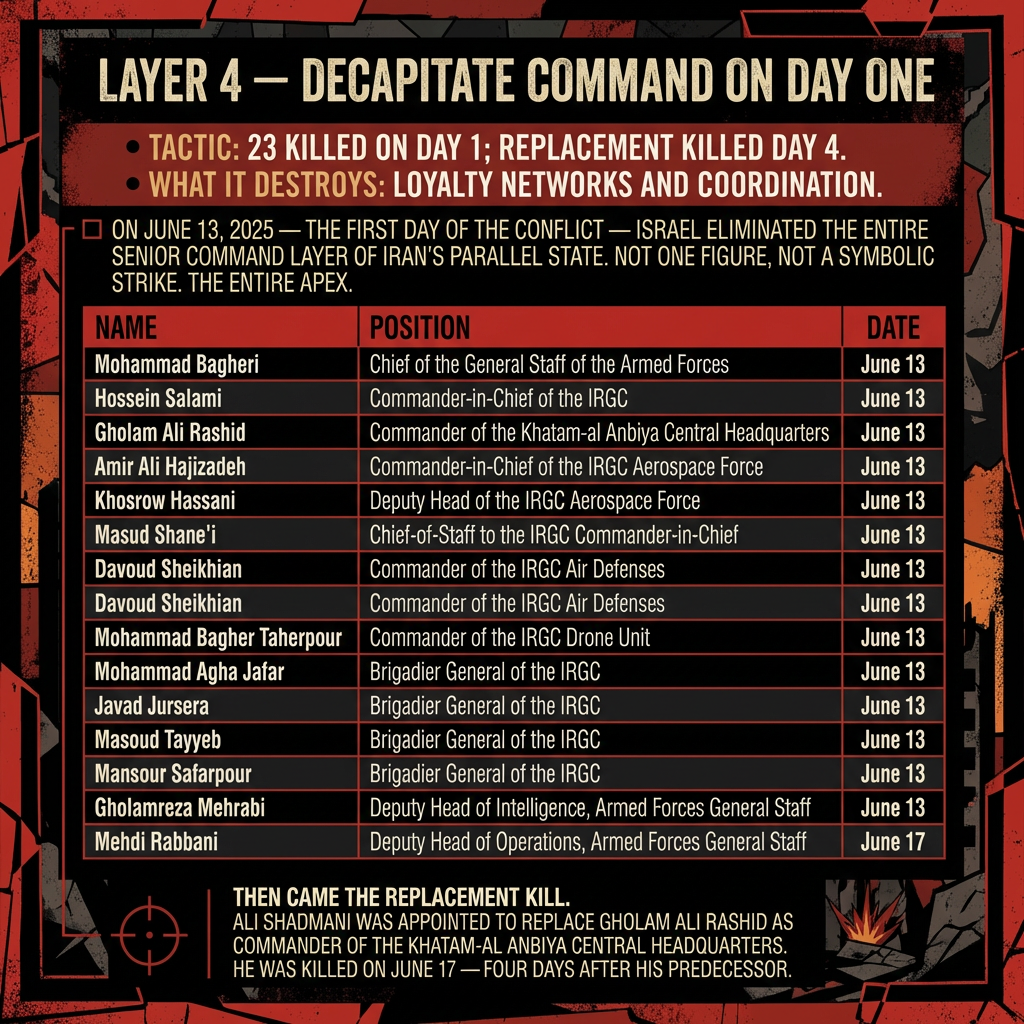
This is the layer that most clearly reveals the doctrine’s ambition. Leadership targeting is not new. What is new, and what distinguishes this from conventional decapitation strikes, is the follow-up kill. When Ali Shadmani was appointed to replace Gholamali Rashid within 96 hours of the opening strike, he was tracked and eliminated before he could consolidate command. This is not a tactical detail. It is a strategic signal: the adversary is reading your internal succession in near-real time, and promotion is a death sentence.
The effect on an organization is not simply the loss of two commanders. It is the collapse of the willingness to lead. Every officer watching Shadmani’s appointment and subsequent elimination understood the message: the adversary has penetrated your communications, your personnel systems, or both. Accepting a command is accepting a targeting solution. The result is an organization that becomes performative rather than functional; officers who hold titles but avoid the communications and decision-making that would make them targetable, and therefore useful.
The loyalty network dimension: Senior IRGC commanders are not interchangeable bureaucrats. They are nodes in a loyalty network built over decades of personal relationships, patronage chains, and informal authority structures that do not appear on organizational charts. When 23 of those nodes are removed simultaneously, the network does not simply reorganize around new nodes. It fragments. The informal authority structures that made the IRGC operationally coherent is the ability to get things done outside formal channels, to move resources, to coordinate across units. These collapse with the killing of the people who embodied them.
Rebuild timeline: 3-7 years if institutional memory survives. If it does not, the simultaneous loss of 23 senior commanders represents a catastrophic institutional memory event and the timeline becomes meaningless. You are not rebuilding an organization; you are building a new one that wears the old one’s uniform.
Layer 5: Erase the knowledge base of the nuclear scientists
Primary Tactic: Targeted assassination of 11 senior nuclear scientists across 12 days.
This is where the doctrine crosses from military targeting into something more deliberate and more consequential: the systematic erasure of a nation’s technical memory.
Nuclear weapons programs are not primarily about facilities or equipment. They are about people, specifically, about the small number of people who carry the tacit knowledge that cannot be written in a manual, transmitted in a briefing, or reconstructed from a blueprint. The knowledge of how to troubleshoot a centrifuge cascade under pressure. The intuition built from years of working with weapons-grade material. The understanding of what the instruments are actually telling you versus what they appear to be saying. This knowledge lives in people, and it dies with them.
Eleven scientists killed in twelve days is not a coincidence of targeting opportunities. It is a deliberate generational strike. The goal is not to slow the program by months or years; it is to create a knowledge gap that cannot be closed by training, recruitment, or technology transfer. Even if Iran rebuilds its facilities, restores its power infrastructure, and reconstitutes its missile production chain, it will be doing so with a workforce that has lost its most experienced practitioners; the people who knew where the bodies were buried, metaphorically and technically.
The apprenticeship problem: Tacit technical knowledge is transmitted through apprenticeship through years of working alongside experienced practitioners who correct mistakes, share intuitions, and model judgment under pressure. When the senior generation is eliminated, the apprenticeship chain breaks. Junior scientists and engineers who might have become the next generation of senior practitioners are left without mentors, without the informal knowledge transfer that formal education cannot replicate, and without the confidence that comes from having been trained by people who had done it before.
The fear multiplier: Beyond the direct knowledge loss, the targeting of scientists creates a deterrence effect on the surviving workforce. Remaining scientists face a choice between continuing work that has made them targets and finding ways to become less visible, less productive, less central, less targetable. The program does not need to be physically destroyed if its practitioners are too afraid to practice.
Rebuild timeline: 10-20 years, and that is a generous estimate. It assumes that Iran can recruit, train, and retain a new generation of nuclear scientists under sanctions, under surveillance, and under the knowledge that their predecessors were system: atically hunted. The generational nature of this damage is the point.
Layer 6: Kill the 2030 capability by eliminating AI and emerging technology researchers
Primary Tactic: Targeted elimination of dual-use AI and technology researchers, including Mohsen Zakerian and Arash Tajanjari, from Day 7 onward.
If Layer 5 is about erasing the past, Layer 6 is about foreclosing the future. The targeting of AI and emerging technology researchers represents a doctrinal evolution that most analysis of the Twelve-Day War has underweighted. The conventional frame for analyzing the war focuses on what Iran had; missiles, nuclear capability, air defense, and how those assets were degraded. Layer 6 targets something different: what Iran was becoming.
Iran’s investment in AI research, drone technology, and dual-use emerging technologies represented a potential force multiplier that could have offset conventional military disadvantages over the coming decade. Autonomous drone swarms, AI-assisted targeting, SIGINT processing automation, and cyber tooling development were all areas where Iranian researchers were making meaningful progress. The elimination of key figures in this ecosystem does not just slow current programs, it collapses the ecosystem itself.
Why ecosystems matter more than individuals: A research ecosystem is more than the sum of its researchers. It is a network of relationships, shared knowledge, collaborative projects, and institutional momentum. When key nodes in that network are eliminated, the ecosystem does not simply continue without them; it fragments. Collaborations dissolve, projects lose their intellectual anchors, and the informal knowledge-sharing that drives innovation stops. The researchers who remain face the same fear multiplier described in Layer 5, with the additional burden of working in a field that has been explicitly identified as a targeting priority.
The 2030 horizon: The significance of this layer is not visible in 2025 or 2026. It becomes visible in 2030, 2035, and 2040 in the capabilities that Iran does not develop, the technologies it cannot field, and the asymmetric advantages it cannot leverage. This is a doctrine designed to shape not just the current conflict but the strategic environment of the next generation.
Rebuild timeline: 15-25 years, assuming the ecosystem can be rebuilt at all under the conditions that will prevail. This is the longest rebuild timeline in the doctrine, and it is intentional.
Layer 7: Remove the watchers
Primary Tactic: Elimination of the Intelligence Commander and two deputies; kinetic strikes on intelligence headquarters infrastructure.
Intelligence services are the nervous system of an authoritarian state. They perform two functions that are equally critical and rarely discussed together: external operations (running networks, conducting foreign intelligence, executing covert action) and internal control (monitoring dissent, managing informant networks, detecting penetrations, and maintaining the surveillance architecture that keeps the population legible to the regime).
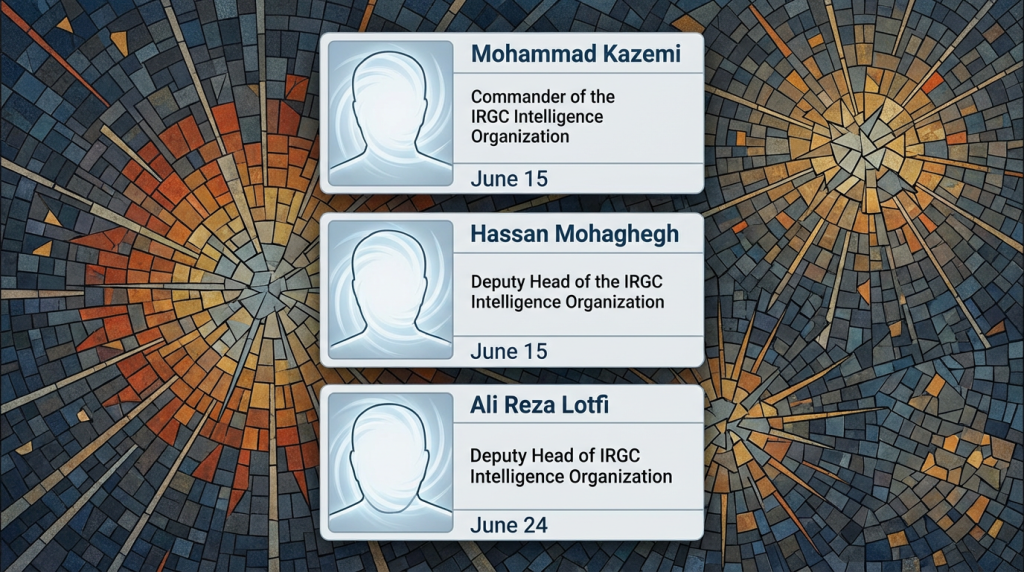
The simultaneous elimination of the Intelligence Commander and his two deputies combined with strikes on physical infrastructure, attacks both functions at once. External operations lose their leadership and institutional memory at the moment when they are most needed (during an active conflict). Internal control loses its coordination capacity at the moment when the regime is most vulnerable to internal pressure.
The penetration feedback loop: There is a specific dynamic that makes intelligence leadership targeting particularly consequential: when an intelligence service loses its leadership under circumstances that suggest deep penetration by an adversary, the surviving organization becomes consumed by counter-penetration paranoia. Every communication is suspect. Every colleague is a potential source. The energy that should go into operations goes into internal security reviews, loyalty investigations, and the paralysis of mutual suspicion. The adversary does not need to maintain active penetration indefinitely; the knowledge that penetration occurred is sufficient to degrade the organization for years.
The internal control vacuum: With intelligence leadership degraded, the regime’s ability to monitor, anticipate, and suppress internal dissent is compromised at precisely the moment when economic disruption (Layer 9), symbolic collapse (Layer 8), and military defeat are creating maximum pressure for dissent. This is not a coincidence in the doctrine’s design.
Rebuild timeline: 5-10 years, optimistic if trust within the organization has collapsed, which the circumstances of the leadership elimination make likely.
Layer 8: Strike legitimacy, not just assets (Narrative infrastructure)
Primary Tactic: Kinetic strikes on IRIB (Islamic Republic of Iran Broadcasting) facilities; destruction of the Palestine Square Countdown Clock in Tehran.

This layer is the one most likely to be dismissed as symbolic, and that dismissal is precisely the misunderstanding the doctrine exploits. Authoritarian states do not survive on force alone. They survive on narrative; the story that converts military defeat into divine test, economic suffering into righteous sacrifice, and political repression into necessary protection. The Islamic Republic has spent 46 years building a narrative infrastructure: a broadcasting system that reaches every household, a symbolic vocabulary of resistance and martyrdom, and physical monuments that make the ideology visible in public space.
The Palestine Square Countdown Clock was not a military asset. It was a legitimacy asset; a daily reminder of the regime’s foundational commitment to the Palestinian cause, its identity as the vanguard of resistance, and its claim to a destiny larger than the Iranian nation-state. Its destruction was not incidental. It was a message delivered to the Iranian public in the most legible possible language: the story you have been told is over.
The broadcasting dimension: IRIB is not simply a propaganda outlet. It is the regime’s primary mechanism for framing reality faster than alternate realities can frame themselves. When military setbacks occur, IRIB’s function is to contextualize them; to provide the narrative scaffolding that allows the population to absorb bad news without drawing conclusions that threaten the regime. Striking IRIB at the moment of maximum military pressure removes that scaffolding. The population experiences the war without the regime’s interpretive layer, which means they experience it as it is.
Why this cannot be rebuilt: You can rebuild a broadcasting studio in months. You cannot rebuild credibility on command. The IRIB that resumes broadcasting after the Twelve-Day War is broadcasting into a population that watched it go silent, that found other sources of information during the silence, and that knows the silence happened. The authority to define reality once broken, does not simply reassert itself when the transmitters come back online.
Rebuild timeline: The physical infrastructure rebuilds in 1-2 years. The legitimacy does not rebuild. It is replaced by something different, something diminished, or something that has not yet been named.
Layer 9: Drain the economic endurance
Primary Tactic: Precision strikes on five critical oil and fuel facilities, including Abadan refinery and Isfahan fuel complex.
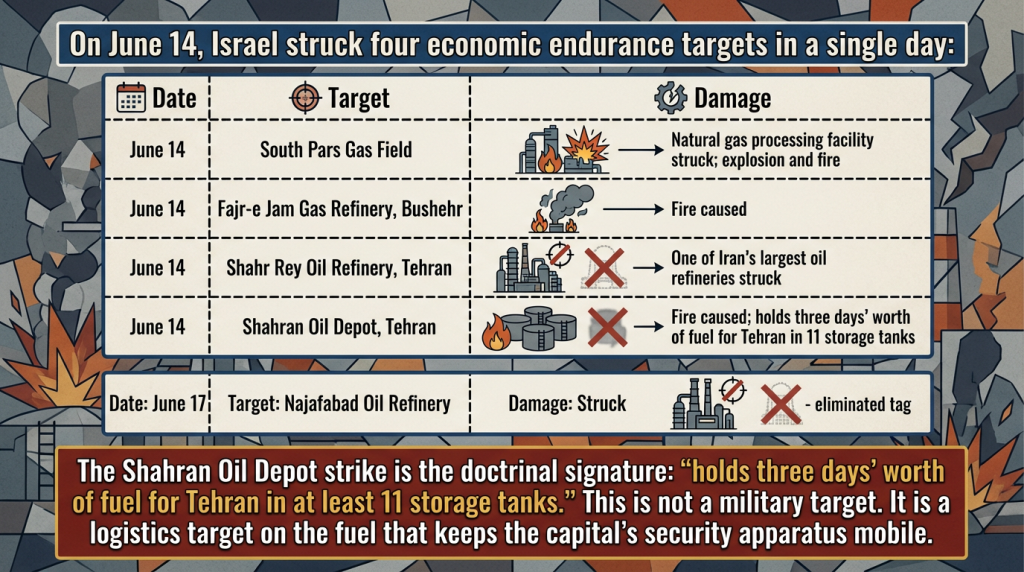
Every authoritarian system runs on a patronage economy; a network of subsidies, salaries, contracts, and benefits that converts loyalty into a rational economic choice. The Islamic Republic’s patronage system is extensive: IRGC-affiliated businesses, Basij stipends, fuel subsidies that keep transportation and heating affordable for the population, and the broader web of state employment that makes the regime the largest employer in the country.
Oil and fuel infrastructure is the liquidity source for this entire system. When refining capacity is degraded, fuel prices rise, transportation costs increase, and the subsidies that make the patronage system function become more expensive to maintain at the moment when revenue is falling. The regime faces a choice between maintaining patronage (and depleting reserves) or reducing patronage (and creating the economic grievances that translate into political pressure).
The timing dimension: This layer is most consequential not in the immediate term but in the medium term of about 6 to 18 months after the strikes, when the cumulative effect of degraded refining capacity, depleted reserves, and rising costs intersects with the political pressures created by military defeat, leadership loss, and narrative collapse. The economic layer does not create a crisis on its own. It amplifies the crises created by every other layer.
The Basij problem: The Basij; the regime’s internal security force and primary instrument of street-level control, is a patronage-dependent organization. Its members are not ideological zealots (though some are); they are people for whom the stipends, benefits, and social status of Basij membership represent a rational economic choice. When the patronage system is strained, the reliability of that force becomes uncertain not through defection, but through the quiet withdrawal of the discretionary effort that makes it effective.
Rebuild timeline: 2-5 years for physical infrastructure, assuming investment, technical capacity, and political stability. The patronage system’s rebuild timeline depends on factors that the other eight layers have already compromised.
The doctrine in full
Read individually, each layer is a military operation. Read together, they are a systems-collapse architecture; a doctrine designed to ensure that each layer’s damage amplifies every other layer’s damage, and that the cumulative effect is not a defeated military but a structurally compromised state.
Each layer is designed to make the next one easier to execute and harder to recover from. The result is not a military victory in the conventional sense but the engineering of a collapse curve: a trajectory in which the damage compounds over time, the recovery options narrow, and the endpoint is not a defeated adversary but a structurally different one. The Twelve-Day War ended on June 24, 2025. The collapse curve it set in motion continues.
Historical grounding
The targeting logic of Operation Rising Lion did not emerge from a vacuum. It draws from a long lineage of strategic thinking about how to collapse a state by attacking its architecture rather than its periphery.
a. The WWII allied bombing campaign
The Allied strategic bombing campaign against Nazi Germany (1943-1945) evolved through a critical doctrinal debate: should bombers target cities (morale) or systems (infrastructure)?
The eventual answer, articulated in the “Oil Plan” and the “Transportation Plan”, was systems. By targeting fuel production and rail networks rather than population centers, the Allies degraded Germany’s ability to move troops, supply fronts, and sustain industrial output. The lesson: destroy the connective tissue, not just the nodes. Operation Rising Lion’s targeting of Iran’s electrical substation at Natanz which shattered centrifuges through power loss rather than direct strike, echoes this logic precisely. Layer 1 of the doctrine: attack the enabling infrastructure, and the primary system collapses on its own.
b. The Israeli campaign in Lebanon (1982): Targeting the command architecture
Israel’s 1982 invasion of Lebanon included a systematic effort to destroy the PLO’s command infrastructure ( headquarters, communications, leadership networks), rather than simply engaging fighters in the field. The goal was to render the organization unable to coordinate, not merely to reduce its numbers.
The lesson was absorbed and later refined: decapitation of command is more efficient than attrition of personnel. But 1982 also revealed the limit; when you remove a command structure without a political solution, you create a vacuum that a more dangerous actor fills. Hezbollah emerged from exactly that vacuum.
This historical echo is not incidental to the Iran analysis. It is a warning embedded in the 2025-2026 events.
c. The U.S. campaign in Iraq (2003): Shock, awe, and the unplanned vacuum
Operation Iraqi Freedom’s initial phase demonstrated the military effectiveness of rapid decapitation in Saddam Hussein’s command structure collapsed within weeks. But the disbanding of the Iraqi Army and de-Baathification created an institutional vacuum that fueled a decade of insurgency. The parallel to Iran in 2026 is structural: a state designed around a single operator, once decapitated, does not transition smoothly to collective governance. The Interim Leadership Council; Pezeshkian, Mohseni-Eje’i, and Arafi inherited tools but not aura. They can issue orders. They cannot reproduce the metaphysical seal that made obedience feel inevitable.
d. The shadow war against Iran’s Nuclear Program (2011–2020): Proof of concept
Before the Twelve-Day War, the coalition had already been running a decade-long proof of concept:
*July 2011: Darioush Rezaeinejad, electrical engineer working on high-voltage switches for nuclear warheads, killed in Tehran by motorcycle gunmen.
*January 2012: Mostafa Ahmadi Roshan, Natanz supervisor, killed by a magnetic bomb attached to his car.
*November 2020: Mohsen Fakhrizadeh, the architect of Iran’s covert nuclear weapons program, killed in a sophisticated ambush in Absard.
These were a sustained, decade-long campaign to prove a thesis: Iran’s most protected programs were penetrable, and the knowledge required to rebuild them was in fact mortal. The Stuxnet → Duqu → Wiper → Flame cyber escalation ladder ran in parallel targeting not only personnel but also industrial confidence. The message was consistent: the nuclear project is not only a technical program. It is a target set.